 Maze Generator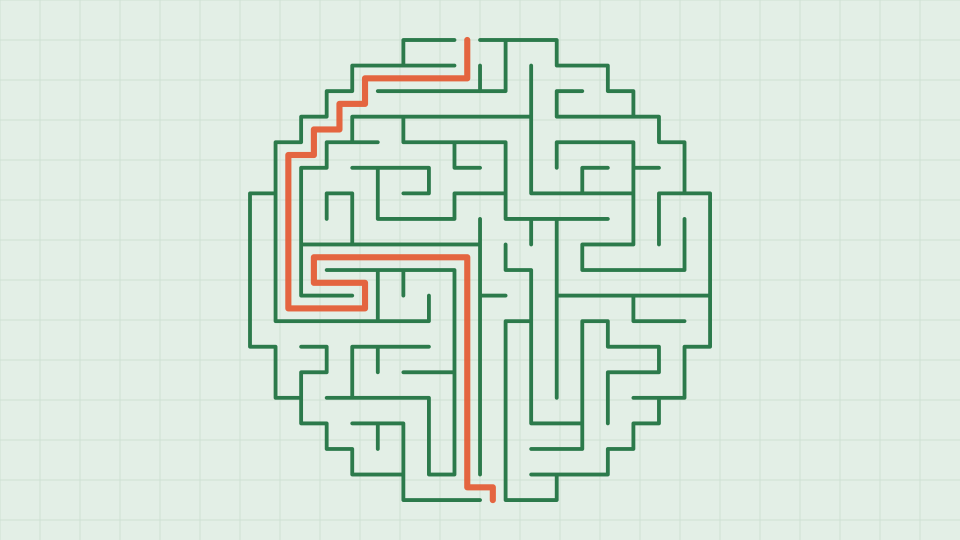
A maze is a small, self-contained problem with a visible goal, which makes it an unusually flexible worksheet. Younger children get fine motor practice; older ones can be pushed toward strategy, estimation and even graph theory. Below are ideas by stage, with generator settings that suit each.
Early years (3 to 5)
Settings: square cells, 6 by 6 to 8 by 8, backtracker with twistiness 20, line thickness 4, and a wide corridor. Print two per page. The goal is a continuous pencil line from start to finish without crossing a wall. Ask children to say "turn" out loud at each corner; it links the motor task to spatial language.
Lower primary (5 to 8)
Settings: 10 by 10 to 15 by 15, backtracker, twistiness 50. Add an inner room and put a sticker or drawing inside it as the treasure. A useful extension is to hand out the same maze (same seed) and time the class, then discuss how those who finished first decided which way to go.
Upper primary (8 to 11)
Settings: hex cells, 14 by 14, Kruskal. Introduce the wall-follower rule: keep one hand on the right wall and you will always reach the exit of a simply connected maze. Have pupils test it and then ask why it works. Compare a circular polar maze, where the rule still works but takes a very long route.
Secondary (11 to 16)
Settings: 25 by 25 or larger, any algorithm. Mazes are spanning trees, and that is a real piece of mathematics. Count cells and count open walls; there is always one fewer open wall than cells. Ask why. Generate the same seed with the backtracker and with Prim and compare dead-end counts from the stats bar. Older pupils can implement a solver in a lesson: the generator uses breadth-first search, which finds the shortest route.
Cross-curricular uses
- Literacy: place a word at each dead end; the solution route spells a sentence.
- Geography: a circular maze with the school at the centre and compass points at the entrances.
- Art: print a light-grey maze and have pupils colour the regions the solution divides.
- Handwriting: tracing the solution path with a pen is a good warm-up for cursive.
Practical notes
Export the answer key separately by toggling the solution and downloading a second SVG. If several pupils need different mazes of equal difficulty, keep every setting the same and change only the seed; that produces mazes that are statistically alike.