 Maze Generator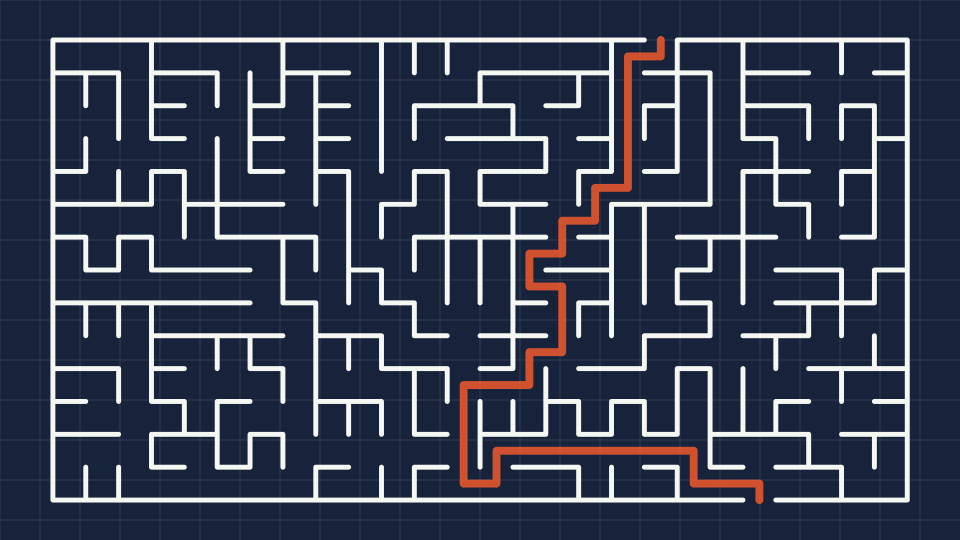
Two mazes with the same number of cells can feel completely different. One is solved by a child in ten seconds, the other keeps an adult busy over coffee. The difference comes down to four things the generator lets you control, and the statistics bar under the maze reports each of them.
Cell count
The most obvious lever. More cells means more decisions. Doubling the width and height quadruples the cell count, so a 40 by 40 maze is not twice as hard as a 20 by 20 one, it is closer to four times harder. The difficulty label in the stats bar uses cell count as its first cut: under 120 cells is easy, under 600 is medium, and so on.
Dead ends
A dead end is a cell with exactly one open side. Every dead end is a trap that costs the solver time. Prim's algorithm produces the most dead ends because it branches constantly; the backtracker produces the fewest because it keeps extending one corridor. Kruskal's lands between them. If you want a maze that looks dense but is forgiving, use the backtracker. If you want one that punishes guessing, use Prim.
Solution length
The number of cells on the correct route, shown as the path length. A long solution with few branches (typical of the backtracker with low twistiness) is tiring but not confusing. A short solution buried in a forest of branches is confusing but quick once found. The ratio of path length to cell count is a useful signal: below about 10 percent the maze is mostly dead wood, above 30 percent the correct route dominates the picture and is easier to spot.
Twistiness
The backtracker's twistiness slider changes how often a corridor turns. Straight corridors let the eye run ahead and evaluate a passage quickly. Twisting corridors hide their destination. Set it high for a harder maze at the same size, or low for a maze that a young child can trace with a finger.
Cell shape
Hexagonal cells have six neighbours instead of four, so branches are more frequent and the eye finds it harder to follow rows. Triangular cells have only three neighbours, but the sawtooth corridors are visually noisy. Both feel harder than a square maze of the same cell count, and both look distinctive on a page.
A practical recipe
- Preschool: square cells, 8 by 8, backtracker, twistiness 20, line thickness 4.
- Primary school: square or hex cells, 15 by 15, backtracker, twistiness 50.
- Adults, coffee break: 25 by 30, Kruskal, line thickness 2.
- Adults, an evening: 60 by 80, Prim, line thickness 1.5, printed on A3.
Generate a few candidates with the solution overlay on. If the route hugs the outside wall or cuts straight across, regenerate; the seed is free.