 Maze Generator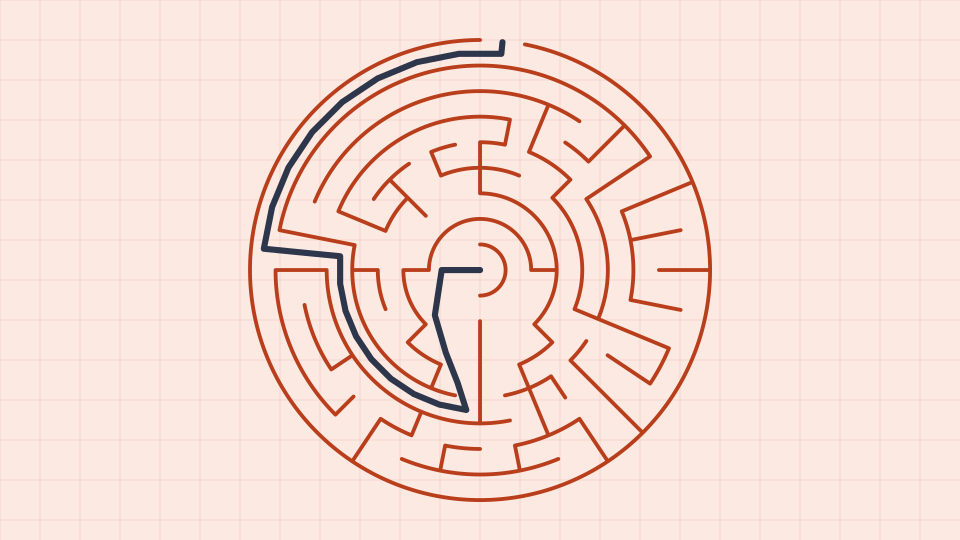
A circular maze can be built two ways. The quick way is to take a square grid and cut a circle out of it, which the generator does when you choose the circle outline with square, hex or triangle cells. The elegant way is the polar grid, where every cell is a slice of a ring. Pick circle and polar together to get it.
Rings and spokes
The centre of a polar maze is a single round cell. Around it sits ring one, then ring two, and so on. Each ring is divided into wedge-shaped cells. Walls come in two kinds: arcs, which separate one ring from the next, and spokes, which separate neighbouring cells on the same ring.
Why cells split as the maze grows
If every ring had the same number of cells, the outer cells would become wide, flat slivers and the corridors would look nothing like the inner ones. To keep every cell roughly the same size, the generator doubles the number of cells in a ring whenever the cells in the previous ring have grown wider than about one and a half times their height. In the drawing, that appears as a ring where every wedge splits in two. A cell that splits has one parent inward and two children outward, so the tree can branch at those points.
Entrances
With the start set to top, the puzzle enters through a gap in the outer wall at the top and finishes at the centre cell. Add an inner room to hollow out the middle few rings into a single open space with one doorway; you can then start from the room and work outward, or start outside and find your way in. The rings option (the height field is relabelled when you choose polar) controls the number of rings; twelve to twenty gives a good page-sized puzzle.
Drawing tips
- Polar mazes look best with a slightly thinner line than square mazes, because the arcs are longer and the wedges near the centre are small.
- The backtracker gives long spiralling corridors that suit the shape. Prim gives a dandelion-seed look.
- For a labyrinth feel (a single path with no branches), use the backtracker with twistiness near zero and a small ring count.
Exporting
The SVG export writes the arcs as true curves, so a circular maze prints smoothly at any size. PNG export rasterises at double resolution, which is enough for a worksheet but will show pixel steps if you scale it up for a poster; use the SVG for anything larger than a page.